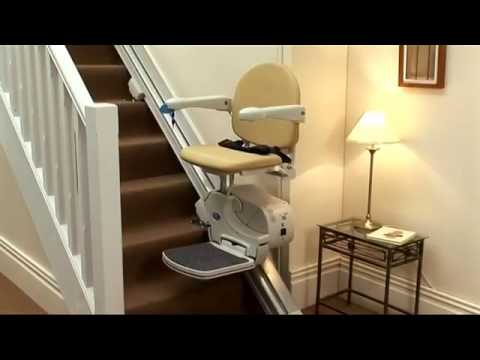
The development of stairlifts is remarkable, and the stairlift is now an increasingly common form of freedom aid. It's not surprising that it has become such a familiar term. Almost every individual will have heard about them at some stage, either as a medical term or by an age-old sales image.
The growth of stairlifts can be tracked back to the first days of gear to have a dual usage, from which we currently take them for granted since purely medical products. This obviously helps us to understand that their main use remains mobility assistance.
The first sort of stairlifts was straight stairlifts, consisting of a car mounted to the ground and top up to a rearward-facing rail. There was no reclining mechanism, just three forwards wheels that were pushed forward or pulled back depending on the direction of movement. The design for straight stairlifts had obvious drawbacks; if the stair elevator started to move the two forward wheels, the vehicle would also reverse itself, making the seat completely stationary. A more modern and improved version of this design came into being http://alexisrxiz019.bravesites.com/entries/general/9-things-your-parents-taught-you-about- with curved stairlifts, whose railings were curved so it could be reclined back, like a traditional seat.
After the public first saw these curved stairlifts, they weren't utilized in homes but rather were used in hospitals as a means of transporting patients up or down stairs. The curve of the backbone required a wheelchair with a curved railing; this configuration allowed the person to easily climb the stairs without needing to place an excess pair of hands on the handlebars. Considering that the medical condition and accessibility of the individual were the primary motives for using this type of equipment, the newest machines have been quickly adopted in many other programs too.
Both straight and curved stairlifts can be found today in a wide range of configuration. Some are powered by batteries, though others can be powered by motors independently. This is very beneficial in nursing homes where electrical motors are simply able to supply sufficient power for an upright platform or using a battery-powered stairlifts, patients can readily and safely access stairs. The old principle of fitting a chair up to a stair railing still applies here; although this has become more of a luxury in some luxury homes.
Many patients prefer to be carried in a wheelchair or in a device like a board stretcher and the curved stairlifts provides a handy way to move from a reclining position to the forward-facing place. Patients are now able to traveling in a straight stairlift without much difficulty, since it has a curved rail and is free from reclining mechanisms. In fact, a curved stairlift allows more freedom of movement than a straight stairlifts, allowing the person to gain much more freedom of movement while in the lift than with a straight stairlift.
Due to the advances in technology, in addition to the improvements in new innovations, you will find far more options available to wheelchair users. These brand new lifts have a variety of functions, they supply comfort, convenience and accessibility to any user. They are great for those who have limited mobility or severe mobility disabilities.
For these and other reasons, this brand new innovation in mobility equipment is becoming increasingly more popular. Producers are continually working on improvements, new layouts and new strategies to make stairlifts even more user-friendly. These wheelchair seats can be a true asset in a home or in a health care setting, since they provide convenience, safety and freedom to people who need it most.